 Published Feb 13, 2026


Kirsten McCarthy / Cats.com
Your cats might be able to tell you apart from a stranger just by your smell, even without hearing or seeing you, according to a Japanese study. Isn’t that something?
The study – Behavioral Responses of Domestic Cats to Human Odor, from the Tokyo University of Agriculture – discovered that cats spent a significantly longer time sniffing tubes that contained the smell of strangers than tubes with their humans’ scent. And it’s no wonder they can tell the difference, given the feline’s strong sense of smell: Cats have more than 200 million scent receptors in the nose, which is more than 40 times as much as we humans have!
“This study is interesting, trying to break down the complexities of cat behavior and their interactions with people, especially with their owners,” says Dr. Chris Vanderhoof, a veterinarian. “We know a cat’s sense of smell is many times better than our own, and they use it in ways to explore their environment that we can hardly imagine.”
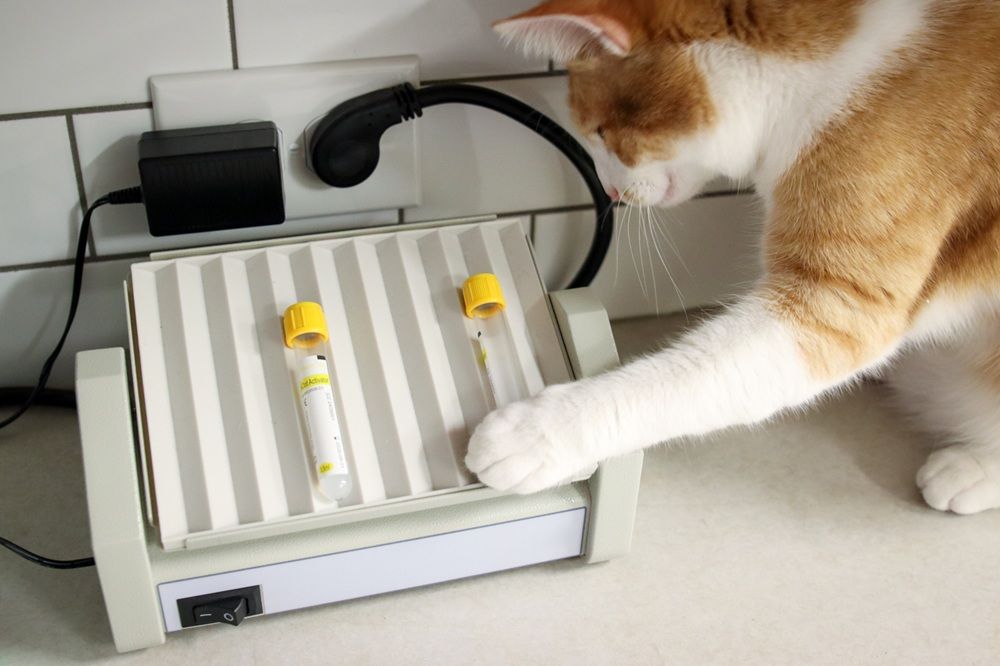
For the study, Japanese researchers used 30 cats to test their reactions – 11 males and 19 females, 25 of which were spayed or neutered. The researchers presented each cat with plastic tubes containing a swab. Each tube had a swab containing the scent of the cat’s owner, or a swab containing the scent of an unknown person of the same sex as the cat’s owner, or a clean swab. The swabs collected scents by people rubbing them under their armpits, behind their ears, and between their toes.
Kirsten McCarthy / Cats.com
Cat subjects spent a few seconds longer sniffing the tubes containing the scent of strangers (about 4.82 seconds), compared to tubes with their owners’ scents (about 2.40 seconds) or a swab with no human scent (about 1.93 seconds). This is congruent with anecdotal evidence, the researchers say.
“Cats are known to respond differently to familiar and unfamiliar people,” the study says. “Weaned kittens sniff unknown female cats longer than they sniff their mothers.”
Dr. Vanderhoof says the findings make sense.
“I think it makes sense that the study found cats spend more time sniffing out an unfamiliar odor compared to an odor obtained from their owner,” he says. “We know that many animals with a superior sense of smell can pick apart different aspects of odors to process. Spending more time with an unfamiliar one so their olfactory senses can pick it apart and decide what to do with it makes sense.”
While the study results suggest that cats can tell the difference between the scents of familiar and unfamiliar people, the researchers caution that it is unclear whether cats can identify specific people by scent.
The researchers also noted that, after sniffing the tubes, the cats rubbed their faces against the tubes – and as we cat people all know, cats love to rub their faces on us and on things! This suggests that smelling things may be an exploratory behavior for cats.
Another interesting finding is that the cats who smelled tubes with the scent of strangers displayed marked lateralization in using one nostril over another.
“This lateralization may have been influenced by the differences in brain hemisphere function,” the study’s authors wrote.
Dr. Vanderhoof finds this nostril element of the study interesting.
Kirsten McCarthy / Cats.com
“How cats use their left or right nostril is certainly fascinating from a standpoint of how this may mean they use different sides of their brain to process different odors, and how this compares to other animals – though less applicable, I think, to what this means to their relationships with humans,” he says.
Dr. Vanderhoof says some points in the study, like observing the cat’s demeanor while they explored odors, were individualized and based on any one cat’s individual behaviors and personality.
“Cats are such individuals and have complex personalities,” he says. “This study only proves that to be even more true.”
The researchers clearly state that more research needs to be done to further explore how well cats can recognize certain people by odors, and other related questions about cats. Dr. Vanderhoof agrees.
“While they were able to make some conclusions – cats for sure spend less time investigating odors they may be familiar with already – the authors noted that this is just the tip of the iceberg for understanding some aspects of a cat’s olfactory senses and how it relates to their personality and behavior,” he says.
-
Miyairi, Y., Kimura, Y., Masuda, K., & Uchiyama, H. (2025). Behavioral responses of domestic cats to human odor. PLoS ONE, 20(5), e0324016. https://doi.org/10.1371/journal.pone.0324016