 Published May 6, 2026


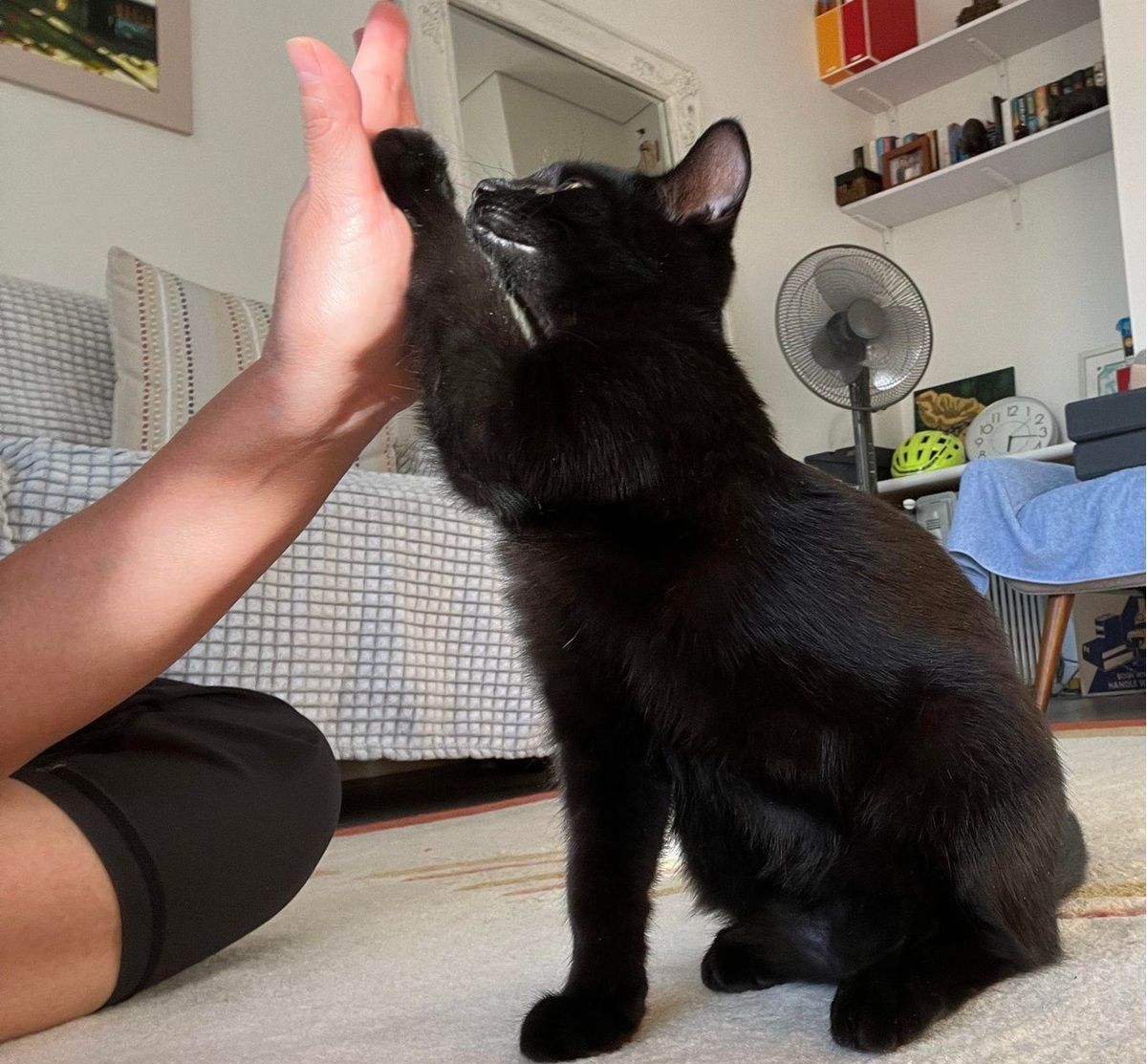
Melina Grin / Cats.com
Women often complain that the men in their lives don’t listen to them, and that they have to repeat themselves several times. Well, maybe cats agree with this – they apparently meow more to greet male parents than female ones!
According to a recent study conducted by researchers at Ankara University in Turkey, cats meow and vocalize in other ways, like trilling, more than twice as much when a male human caregiver returns home compared to a female. But that doesn’t mean cats show more enthusiasm for dads than moms; in fact, no difference showed between men and women with other cat greeting behaviors, like rubbing on us and tail motions. (So, no, my fellow females – I don’t think we’re getting dissed by our cats!)
The study examined the behavior of 31 cats, owned by the same people – 58 percent women, and 42 percent male – for at least six months, between 2022 and 2024. The cats – 18 male and 13 female – were all at least 8 months old and considered fully grown. Study participants wore small cameras and recorded the first 100 seconds after they walked in the door when coming home. On average, cats gave men 4.3 meows in those 100 seconds, while cats gave women only 1.8 meows.
What gives? The researchers believe it’s not about a cat’s preference for men over women, but about a smart communication strategy. Women often interact with and pay attention to their cats more, so cats may not feel like they need to vocalize as much to get attention. With men, cats may feel like they need to be extra vocal to get undivided attention.
“Female caregivers are generally more verbally interactive, more skilled at interpreting feline vocalizations, and more likely to mimic the vocalizations of their cats,” the study states. “It is therefore possible that male caregivers require more explicit vocalizations to notice and respond to the needs of their cats, which in turn reinforces cats’ tendency to use more directed and frequent vocal behavior to attract their attention.”
Mikel Delgado, a cat behaviorist and senior research scientist at Purdue University, expressed skepticism in an interview with The New York Times. For one thing, he said, the study did not account for factors like how long the cats were alone before the humans returned home, and whether the cats were hungry.
“We need to be careful about interpreting this as a clear finding that is going to translate to all cats,” Delgado told the newspaper.
Overall, the study points to the complex and intriguing nature of the feline, the study’s authors wrote.
“Greeting behavior in cats toward their caregivers constitutes a complex, multidimensional phenomenon that defies straightforward explanation,” the study’s conclusion states. “These behaviors encompass a range of elements – some closely interconnected, others more independent – and the influence of demographic factors remains challenging to capture, even outside a survey framework.
“We believe that our pilot study provides a valuable foundation for future research, in which larger sample sizes and the inclusion of additional variables … may reveal further subtleties in feline behavioral patterns and offer deeper insights into the social lives of domestic cats.”
Certainly, many men make wonderful, doting cat caregivers. We wrote recently about one Olympian athlete – Ilia Malinin, a star figure skater – who loves his cats so much that he posted a picture on social media of one of his two cats, Mysti, wearing a reproduction of his Gold medal. In a questionnaire published in Vulture, Malinin said that getting his two cats – Mysti and Miu Miu – was very impactful, and that he was jealous that his sister got more attention from the cats than he did!
Cats have also charmed many men who weren’t “cat people” into falling for them. Check out this sweet story we published about a man named Caleb, who found a stray tabby kitten outside and didn’t know what to do with her. But he kept Nala, who became a total daddy’s girl.
This Turkish study is one of many feline studies we have written stories about over the past couple of years. One study, conducted by researchers at Azabu University in Japan, found evidence that cats develop picture-word association faster than human babies. Another study from Washington State University found that cats can make just as great therapy animals as dogs. A study from Ohio State University suggests that cats may even fake illnesses in order to communicate something to their humans – wow!
Every study we see seems to further affirm what we cat lovers know: that our animals are exquisite and fascinating. And the more we learn, the more we know that we can never fully solve the mystery of what makes cats tick.