
 Published Apr 3, 2026


Amy Brown-Towry / Cats.com
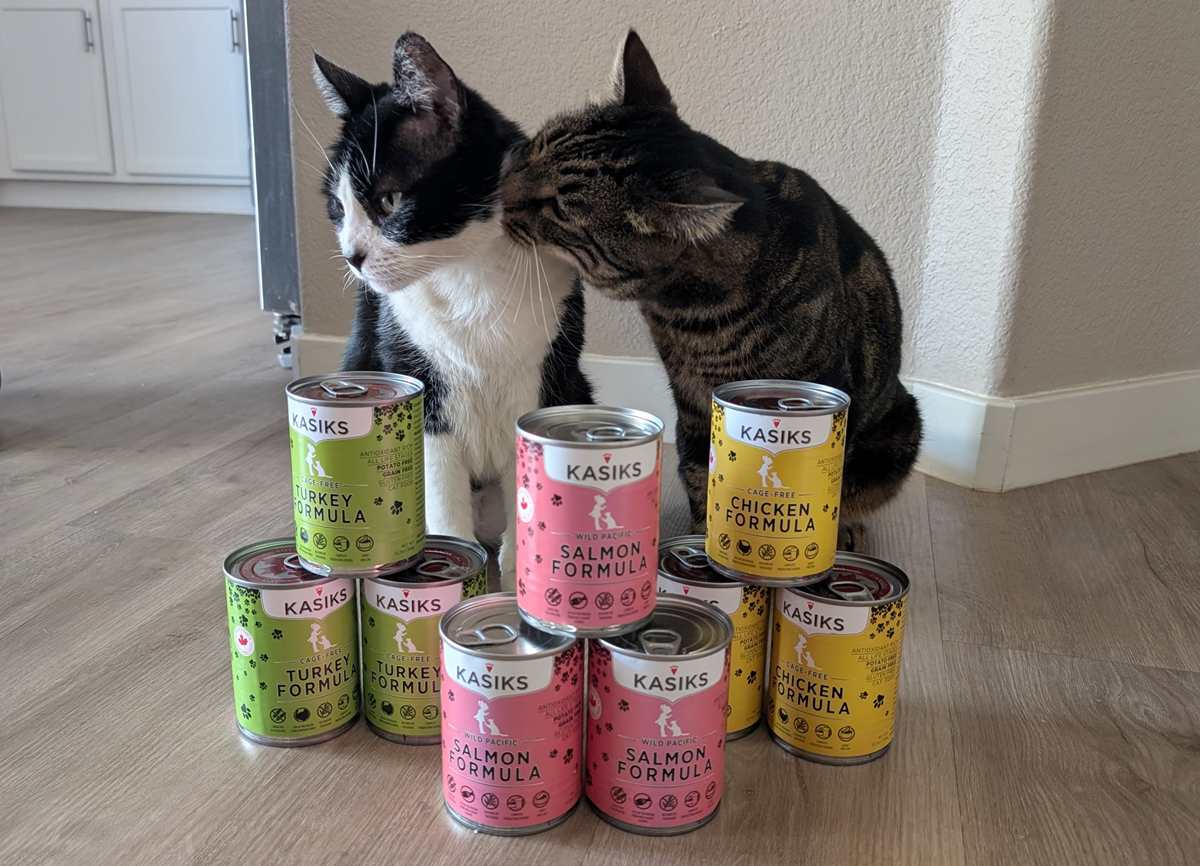
It promises limited-ingredient, gum-free food for sensitive cats, but is KASIKS a healthy choice for your cat? Find out in our unbiased KASIKS cat food review.
The Cats.com Standard—Rating KASIKS on What Matters
We’ve analyzed KASIKS and graded it according to the Cats.com standard, evaluating the brand on species-appropriateness, ingredient quality, product variety, price, customer experience, and recall history. Here’s how it rates in each of these six key areas.
Ratings
- Species-Appropriateness – 7/10
- Ingredient Quality – 8/10
- Product Variety – 5/10
- Price – 7/10
- Customer Experience – 7/10
- Recall History – 10/10
Overall Score: 7.3/10
We give KASIKS cat food a 45 out of 60 rating or a B+ grade.
About KASIKS
The KASIKS story begins in the 1980s when fisherman and entrepreneur Mike Florian started a business called the Taplow Company. The company originally sold fish feed, but the staff guard dogs couldn’t seem to stop eating the stock. According to company legend, the Taplow team went to work developing food that would satisfy the dogs and keep them out of the fish food.
Apparently, they were successful. The company’s first venture into dog food was called FirstMate. The company later introduced Skoki and KASIKS. Today, we’ll focus on the latter, a line of limited-ingredient food for dogs and cats.
Sourcing and Manufacturing
KASIKS foods are manufactured in a company-owned cannery in British Columbia, Canada. Because FirstMate owns and operates its own facility, the company maintains full control over sourcing, production, and distribution. This vertical integration is one of the brand’s strongest selling points, allowing for tighter oversight and greater transparency than many competitors who rely on third‑party manufacturers.
The company states that all ingredients and processes are cruelty‑free. Their poultry is sourced from humanely raised Canadian farms, and all fish ingredients come from sustainably managed, wild‑caught fisheries. KASIKS also emphasizes adherence to Canadian animal welfare regulations throughout raising, transport, and slaughter.
KASIKS does not conduct laboratory testing on animals. Instead, they gather feeding and performance data through a network of breeders, rescue organizations, and their own pets. This approach aligns with their commitment to humane practices while still ensuring that their foods meet nutritional and palatability standards.
Has Kasiks Cat Food Been Recalled?
It doesn’t appear that KASIKS has ever been recalled.
What Kinds of Cat Food Does Kasiks Offer?

Amy Brown-Towry / Cats.com

Amy Brown-Towry / Cats.com
KASIKS is a wet food-only brand. Each of their formulas features a single source of animal protein like chicken, turkey, or salmon. They even offer a recipe made with eco-friendly insect protein. The Fraser Valley formula contains protein from black soldier fly larva to complement the sole source of animal protein, boneless salmon.
Their wet foods are packaged in BPA-free cans and are free from potentially problematic thickeners like carrageenan and guar gum. In place of artificial binders and thickeners, KASIKS wet foods rely on natural starches like pea starch to maintain their ideal thickness and palatable paté texture.
Of their decision to include carbohydrates in their canned foods, KASIKS comments: “Carbohydrates have some important body functions and can have a protein-sparing effect in the body. If the diet supplies adequate carbohydrates, protein will be spared from being used for energy and can instead be used for tissue repair and growth. Furthermore, carbohydrates also supply carbon skeletons for the formation of amino acids by the body.”
KASIKS cat food comes in 5.5-ounce and 12.2-ounce cans.
KASIKS Cat Food – Top 3 Recipes Reviewed
| Product Name | Food Type | Price | Our Grade |
| KASIKS Cage-Free Chicken Formula Grain-Free Canned Cat Food | Wet | $0.34 per oz | B+ |
| KASIKS Wild Coho Salmon Formula Grain-Free Canned Cat Food | Wet | $0.36 per oz | A- |
| KASIKS Cage-Free Turkey Formula Grain-Free Canned Cat Food | Wet | $0.34 per oz | B |
#1 KASIKS Cage‑Free Chicken Formula (Wet)
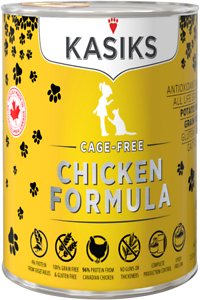
Chicken appears to be the primary protein source in this wet cat food.
Chicken appears to be the primary protein source in this wet cat food.
This limited‑ingredient KASIKS recipe is built around boneless cage‑free chicken, water, and a short list of supplements. According to the company, 96% of the total protein content comes from chicken, making it a single‑protein formula suitable for many cats with food sensitivities.

Amy Brown-Towry / Cats.com

Amy Brown-Towry / Cats.com

Amy Brown-Towry / Cats.com
The food contains no gums or traditional thickeners. Instead, it uses pea starch, which is less controversial than carrageenan but still contributes a significant amount of carbohydrate. Based on the current guaranteed analysis, the recipe contains about 24% carbohydrates on a dry matter basis, which is high for a wet food and reduces its species‑appropriateness.
In addition to vitamins, minerals, and taurine, the recipe includes small amounts of kale, berries, and coconut, which the company describes as sources of antioxidants.
Overall, this food is high in protein, moderate in fat, and high in carbohydrates for a wet diet. While it may be a good option for cats with food sensitivities who need a simple, single‑protein formula, its carbohydrate content makes it less ideal for those seeking a low‑carb, carnivore‑appropriate food.
The food contains 331 calories per 12.2‑oz can, or 27 calories per ounce.
Ingredients
Boneless Chicken, Water Sufficient For Processing, Pea Starch, Sodium Chloride, Calcium Carbonate, Dicalcium Phosphate, Potassium Chloride, Choline Chloride, Taurine, Kale, Minerals: (Zinc Proteinate, Iron Proteinate, Copper Proteinate, Manganese Proteinate, Calcium Iodate) Vitamins: (Vitamin E Supplement, Niacin, Vitamin A Supplement, Thiamine Mononitrate, Riboflavin, Biotin, Vitamin B12 Supplement, D-Pantothenic Acid, Folic Acid, and Vitamin D3 Supplement) Blueberries, Raspberries, Cranberries, and Coconut.
Ingredients We Liked: Boneless Chicken
Ingredients We Didn’t Like: Pea Starch
Guaranteed Analysis

Dry Matter Basis
Caloric Weight Basis
Pros
- Single‑protein, limited‑ingredient recipe suitable for many cats with food sensitivities
- 96% of protein from cage‑free chicken
- Free of grains, potatoes, and common allergens
- Lower calorie density may help with portion control for some cats
Cons
- High carbohydrate content for a wet food (~24% DMB)
- Pea starch is the third ingredient, contributing to the carb load
- A moderate fat level may not satisfy cats needing higher fat for weight gain
- Texture may be too firm for some cats due to lack of gum
#2 KASIKS Wild Coho Salmon Formula Grain-Free Canned Cat Food
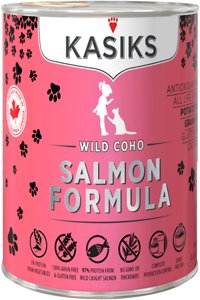
Salmon appears to be the primary protein source in this wet cat food.
This KASIKS paté is made primarily from boneless, skinless wild‑caught salmon, which the company states accounts for 97% of the food’s total protein content. Like other KASIKS recipes, it features a short, limited‑ingredient list with salmon first, followed by water, pea starch, and vitamin and mineral supplements. Small amounts of kale, berries, and coconut appear at the end of the ingredient list as trace antioxidant sources.

Amy Brown-Towry / Cats.com

Amy Brown-Towry / Cats.com

Amy Brown-Towry / Cats.com
Based on the current guaranteed analysis, this recipe is high in protein, moderate in fat, and moderate in carbohydrates for a wet food. Its estimated carbohydrate content is about 14% on a dry matter basis, which is higher than ideal for a carnivore‑appropriate diet but still lower than many dry foods and even some wet foods in the KASIKS lineup.
The Coho Salmon formula is a good option for cats who enjoy fish‑based foods but need a simple, single‑protein recipe without vague ingredients like “fish,” “fish meal,” or “ocean whitefish.” Its limited‑ingredient profile makes it suitable for many cats with food sensitivities.
Ingredients
Boneless/Skinless Salmon, Water Sufficient for Processing, Pea Starch, Sodium Chloride, Calcium Carbonate, Dicalcium Phosphate, Potassium Chloride, Choline Chloride, Taurine, Kale, Minerals: (Zinc Proteinate, Iron Proteinate, Copper Proteinate, Manganese Proteinate, Calcium Iodate), Vitamins: (Vitamin E Supplement, Niacin, Vitamin A Supplement, Thiamine Mononitrate, Riboflavin, Biotin, Vitamin B12 Supplement, D-Pantothenic Acid, Folic Acid, Vitamin D3 Supplement), Blueberries, Raspberries, Cranberries, Coconut.
Ingredients We Liked: Boneless/Skinless Salmon
Ingredients We Didn’t Like: Pea Starch
Guaranteed Analysis
Dry Matter Basis
Caloric Weight Basis
Pros
- Single‑protein, fish‑based formula ideal for cats who can’t tolerate mixed‑fish recipes
- High protein content (59% DMB)
- No gums or carrageenan
- Limited-ingredient list supports cats with allergies or sensitivities
- Very low calorie density (24 kcal/oz) helpful for cats needing weight control
Cons
- Still higher in carbs than most premium wet foods
- Low‑moderate fat content (16% DMB) may not be ideal for active or underweight cats
- Contains plant ingredients (kale, berries, coconut) with minimal feline benefit
#3 KASIKS Cage-Free Turkey Formula Grain-Free Canned Cat Food
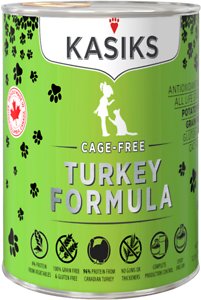
Turkey appears to be the primary protein source in this wet cat food.
This KASIKS recipe centers around boneless, skinless turkey, with the company stating that Canadian turkey provides 96% of the food’s total protein content. Unlike the chicken and salmon formulas, this recipe includes both muscle meat and a small amount of chicken liver, which adds flavor and contributes additional nutrients.

Amy Brown-Towry / Cats.com

Amy Brown-Towry / Cats.com

Amy Brown-Towry / Cats.com
Aside from this variation, the formula follows the familiar KASIKS pattern: meat first, followed by water, pea starch, and a short list of supplements. Trace amounts of kale, berries, and coconut appear at the end of the ingredient list as minor antioxidant sources.
Based on the current guaranteed analysis, this food is high in protein, moderate in fat, and high in carbohydrates for a wet food. Its estimated carbohydrate content is about 24% on a dry matter basis, which is significantly higher than ideal for a carnivore‑appropriate diet.
While this poultry paté is simple, limited‑ingredient, and free of common allergens, its carbohydrate load makes it less species‑appropriate than many other wet foods.
The food contains 27 calories per ounce.
Ingredients
Boneless Turkey, Water Sufficient For Processing, Pea Starch, Chicken Liver, Sodium Chloride, Calcium Carbonate, Dicalcium Phosphate, Potassium Chloride, Choline Chloride, Taurine, Kale, Minerals: (Zinc Proteinate, Iron Proteinate, Copper Proteinate, Manganese Proteinate, Calcium Iodate), Vitamins, (Vitamin E Supplement, Niacin, Vitamin A Supplement, Thiamine Mononitrate, Riboflavin, Biotin, Vitamin B12 Supplement, D-Pantothenic Acid, Folic Acid, Vitamin D3 Supplement), Blueberries, Raspberries, Cranberries, Coconut.
Ingredients We Liked: Boneless Turkey, Chicken Liver
Ingredients We Didn’t Like: Pea Starch
Guaranteed Analysis
Dry Matter Basis
Caloric Weight Basis
Pros
- Single‑protein, limited‑ingredient recipe centered on turkey
- No gums or carrageenan, uses pea starch instead
- High protein content on a dry matter basis (45%)
- Consistent texture without thickeners, which some cats prefer
Cons
- High carbohydrate content for a wet food (~24% DMB)
- Pea starch is the third ingredient, contributing significantly to carbs
- Moderate fat level may not be ideal for cats needing higher-fat diets
What Do Customers Think of Kasiks Cat Food?
There’s not a lot of talk going on about KASIKS, but most discussions are positive. Customers appreciate the brand’s decision to avoid gum-based thickeners and admire its limited-ingredient formulations.
Positive Reviews
“Love the fact that this food is made with human grade meats. It is a moist pate with some broth through out the can. I stir the broth into the pate and am glad that this brand’s pate is moist. Our stray cat seems to really like this food.” – Diane, reviewing KASIKS Chicken Formula on Apr 9, 2026
“This has stopped my cat from throwing up.” – Roberta, reviewing KASIKS Turkey Formula on Feb 4, 2025
Negative Reviews
“I purchased this food after my experience with its sister brand, Firstmate, was lukewarm. Firstmate was rather watered down, so I figured this more expensive version with similar ingredients would be less so. I was wrong. For the price, you’re better off buying a food that’s more dense and adding your own water to it. As for cat approval, the ingredients are high quality, but my cats weren’t excited by it.” – Amy reviewing KASIKS Turkey Formula on January 31, 2025
“I was really hoping my boys would like this food. Good ingredient list, but they do not like the taste or the texture. I tried MANY toppers to get them to eat it, but no luck. The quest continues to find a healthier food that they will eat as well as they like their Friskies indoor pate.” – Patti, reviewing KASIKS Chicken Formula on Jul 29, 2025
How Much Does Kasiks Cat Food Cost?
For an average 10‑lb cat needing around 200 calories per day, you’d feed roughly 0.6 cans per day of the chicken or turkey formulas, or about 1.5 cans per day of the lower‑calorie salmon formula. Based on current Chewy pricing, that works out to an average of about $2.20 per day, placing KASIKS in the mid‑range for wet cat food. It’s comparable in price to brands like Merrick or Wild Calling, which are not cheap but far from the most expensive options on the market.
Where To Buy Kasiks Cat Food?
You can buy KASIKS in pet specialty stores throughout Canada in the United States. The brand is also sold through online retailers, including Amazon and Chewy.
Overall, Is Kasiks a Good Choice?
KASIKS is one of the few pet food brands willing to experiment in meaningful ways. Many companies have abandoned grains, potatoes, and other high‑starch ingredients, but very few have taken the extra step of eliminating gums entirely. KASIKS has, and that alone sets them apart in a crowded market. Their willingness to innovate also shows up in products like the Fraser Valley Grub Formula, an insect‑protein recipe that reflects a growing interest in sustainable alternatives.
Although the KASIKS lineup is small and the brand isn’t widely known, their foods appear to be safe, consistent, and made from high-quality, clearly named ingredients. Each recipe is limited‑ingredient, single‑protein, and free of common allergens, making the brand appealing for cats with food sensitivities.
That said, KASIKS foods tend to be higher in carbohydrates than ideal for obligate carnivores. Even without gums or grains, the use of pea starch pushes the carb content higher than many wet foods. The Coho Salmon Formula is the lowest-carb option at around 14% DMB, while the chicken and turkey formulas land closer to 24% DMB.
If you’re looking for a simple, clean, limited‑ingredient food and are comfortable with a moderate carbohydrate load, KASIKS is a solid mid‑range choice. For those prioritizing a more strictly carnivore‑appropriate diet, sticking to their lower‑carb salmon recipe is the best choice.
Also Read: What’s Best Limited Ingredient Cat Food? We Tested 10 Recipes
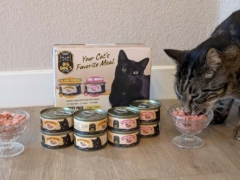
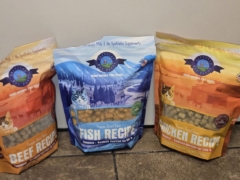
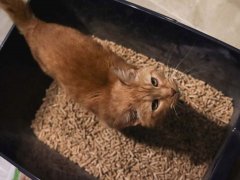
Just a warning out there for anyone wishing to try this food. It’s possibly the most unappetizing wet food in existence. I was given four huge cans of the salmon formula for free, and trying to get my two normally not-picky cats to eat this stuff feels like pulling teeth. I first offered it to my older male, and he took one or two bites during the entire day. I finally let my younger male have it last night, and he reluctantly ate it. The other half of the can is currently sitting in a dish on my floor completely untouched. They are deliberately ignoring it despite being hungry. I don’t know what they’re putting in this food, but I would not recommend it if two normal, healthy, hungry cats are refusing to eat it.