
 Published Mar 16, 2026


Kirsten McCarthy / Cats.com
Basal cell tumors in cats are the most common type of skin tumor that occurs in cats. In this article you’ll learn why they occur, how to potentially recognize one, and how they’re treated.
Quick Overview: Basal Cell Tumors in Cats
 Other Names: None
 Common Symptoms: Basal cell tumors often appear as singular, dark colored, firm, raised, hairless skin growths.
 Requires Ongoing Medication: No
 Vaccine Available: No
 Treatment Options: Surgical removal is curative in most cases of benign basal cell tumors. For the malignant form called basal cell carcinoma, additional radiation or chemotherapy may be needed after surgical removal to prevent recurrence or spread to other areas of the skin.
 Home Treatment: Long-haired cats are more often affected, making skin tumors hard to find. Make sure to regularly brush your longhaired cat to remove mats that may be confused with a skin tumor; Regular brushing and grooming of longhaired cats can be an effective way to detect skin tumors that otherwise may not be visible; While basal cell tumors are the most common single skin tumor in cats and are often benign (non-cancerous), a majority of other skin growths on cats are malignant. Even small skin growths on cats should be evaluated by a vet to determine the tumor type.
What is a Basal Cell Tumor?
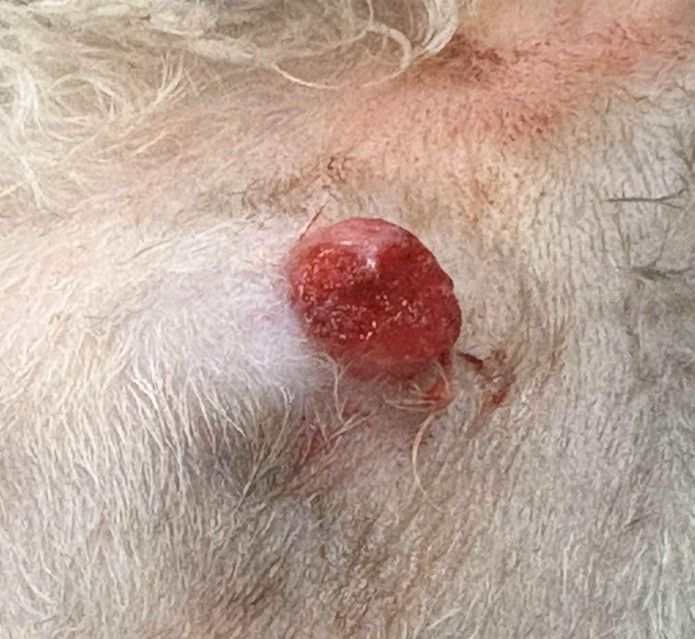
This is a suspected basal cell tumor in a longhaired cat. You can see the raised skin nodule on top of which an ulcerated portion has developed. Chris Vanderhoof / Cats.com
A basal cell tumor is a type of tumor seen on the surface of a cat’s skin. In cats, skin tumors are the second most common type of tumor (the first being lymphoma, which occurs more as an internal type of tumor). Of skin tumors, basal cell tumors are the most common single tumor type, comprising about ¼ of those diagnosed in cats.
The next most common skin tumor types are mast cell tumors (MCT), and squamous cell carcinoma (SCC).
Basal cells make up the bottom-most layer of the outer layer of skin, the epidermis. As we know, everyone’s skin turns over regularly and is constantly renewed, with the outermost layer being shed and replaced by layers beneath. The job of basal cells is to produce new skin cells at the very bottom layer of our skin. Basal cells are also associated with structures deep in the outer layer of skin including sweat glands, sebaceous (oil) glands, and hair follicles.
Basal cell tumors can be either benign (non-cancerous) or malignant (cancerous). Fortunately, only a small percentage of basal cell tumors are malignant. Malignant basal cell tumors are called basal cell carcinoma.
Causes of Basal Cell Tumors
There is no one single cause for basal cell tumors. As with most tumor types, there may be one predominant cause in a particular cat or a combination of causes may be related.
Basal cell tumors are more common in older cats, averaging 10-11 years of age, implying that age and immunity may be one contributing factor.
There are certain breeds of cats that are considered to be at higher risk for developing basal cell tumors. This means there may be a congenital or hereditary component in these breeds:
- Siamese
- Persian
- Norwegian Forest
- Himalayan
Environmental factors may also be related, such as exposure to sunlight and other UV radiation. UV radiation may be a greater factor in development of malignant basal cell carcinomas.
Symptoms of Basal Cell Tumors in Cats
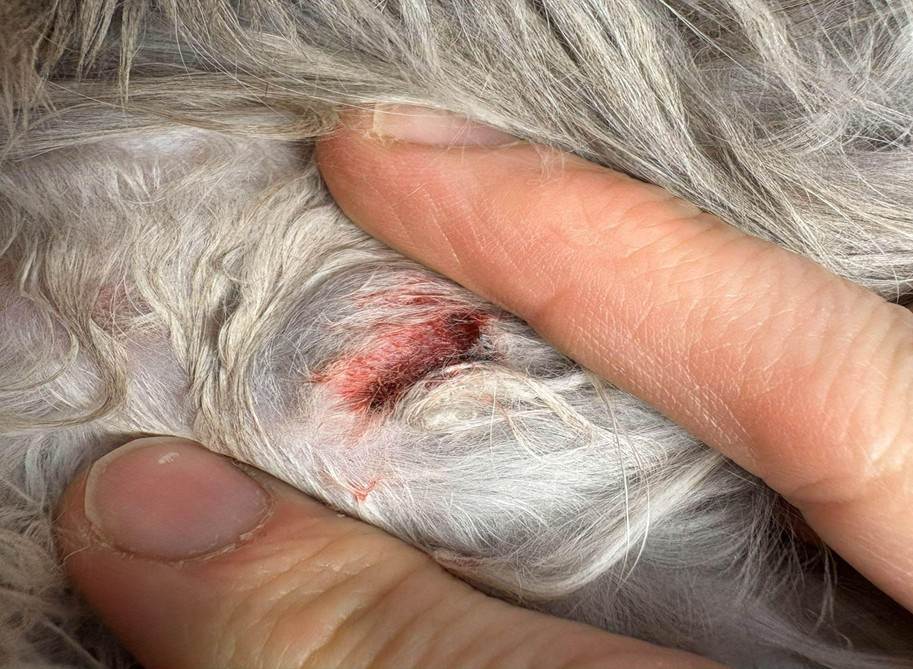
This is the same skin growth as pictured at the beginning of this article but about two months earlier. It was only discovered because it became ulcerated and began to bleed. Because they occur in longhaired cats most often, they can be hard to see early on. Chris Vanderhoof / Cats.com
Benign Basal Cell Tumors
Basal cell tumors occur as single growths on the skin. They can occur anywhere on the skin, but the head, neck, and shoulders are the most common sites to find them.
These tumors are typically firm, have no hair, and are well-raised off the skin. They can resemble a round stalk raised from the skin surface.
Sometimes, basal cell tumors may develop ulceration or irritation on their surfaces or may become cystic. A cyst is a sac-like component that may fill with fluid or other material. This would be more common in basal cell tumors that arise from sweat glands or sebaceous glands.
When felt/examined, basal cell tumors can be moved around with the surrounding skin meaning they are not fixed to deeper connective tissue layers. This may be one way to differentiate them from sarcomas, a less common (about 15% of feline skin tumors) but potentially more urgent type of tumor in cats. Fibrosarcomas are tumors that develop from cells beneath the skin in the tissue layers between skin and muscle. They may also appear similar to basal cell tumors but are more fixed beneath the skin and will grow more rapidly.
Basal Cell Carcinoma
Basal cell carcinomas are rare compared to benign basal cell tumors. They can also appear differently.
Basal cell carcinomas tend to be less raised off the skin and more ulcerated. While they may start out as a single lesion, the ulcerated tissue tends to spread around the nearby skin. In this way, they may appear similarly to squamous cell carcinoma of the skin (the third most common skin tumor type in cats).
Complications of Having Basal Cell Tumors
A large majority of basal cell tumors in cats are fortunately benign.
Even so, because they can occur anywhere on the skin, surgical removal of one may be more challenging if it occurs in an area like the head where there is less stretch to the skin.
A small percentage of basal cell tumors are basal cell carcinomas, the malignant form of this tumor. Basal cell carcinomas are often surgically removed just like other basal cell tumors, however additional treatment follow-up may be needed.
Basal cell carcinomas rarely metastasize (spread) to other organs like the lungs. However, they are more likely to occur in multiple areas on the skin or spread on the skin from an initial location.
Diagnosis of Basal Cell Tumors in Cats
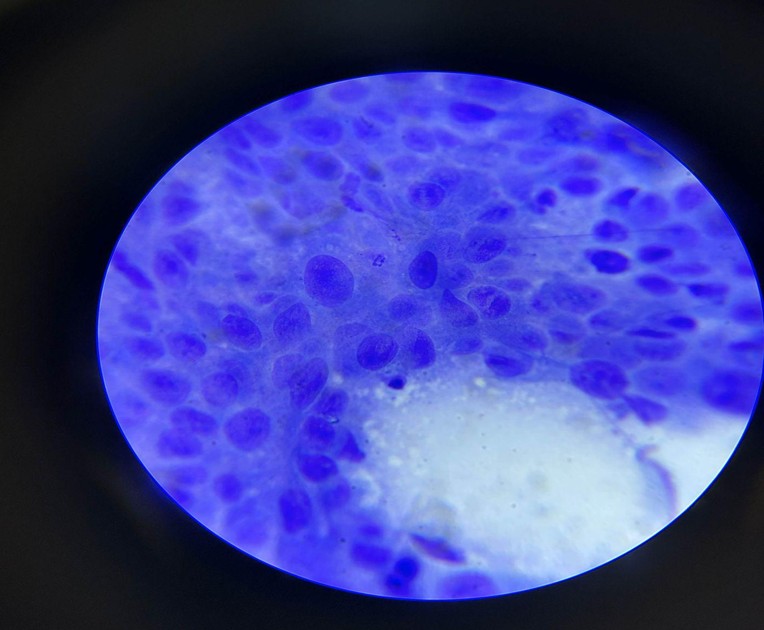
A cytology where cells are collected with a small needle and viewed under a microscope, is one initial way to diagnose a basal cell tumor. This sample was collected from a suspected basal cell tumor. At the least, other top skin tumors including mast cell tumor, squamous cell carcinoma, and sarcoma, were able to be ruled out, leaving a basal cell tumor as the most likely. Chris Vanderhoof / Cats.com
A basal cell tumor may be suspected based on your veterinarian’s preliminary exam. However, other tumors like sarcoma, mast cell tumors, and squamous cell carcinoma, can appear similar.
A first step your vet will take is to collect a sample using a needle and syringe. For most cats, this can be done during the exam and is no more stressful than getting an injection. Some cats may require sedation if they tend to be fearful, don’t tolerate handling well, or don’t do well with shots.
The needle and syringe are used to “suck up” cells from the tumor and put them on a slide to be viewed under a microscope.
Your vet may be able to identify the tumor type based on their exam of the slide during your visit. However, in many cases, these samples will be sent out to a lab for a pathologist to look at. This provides a greater assurance of the tumor type.
Sometimes, a cytology is not definitive but can still be helpful to rule out other tumor types and provide guidance. In many cases, basal cell tumors can be diagnosed by cytology and differentiated from other common skin tumors.
A cytology may be a first step prior to surgical removal of the tumor, as it can help your vet understand the best way to address the tumor surgically. Once removed, your vet will recommend sending out the tumor for a tissue biopsy, or histopathology.
A tissue biopsy of the growth, where the whole tumor is removed and sent to a lab for a pathologist to examine, is called histopathology. This is a much more definitive way to confirm a basal cell tumor. This is also the best way to differentiate a benign tumor from a malignant one.
Basal cell tumors can actually be subcategorized into different types, which can only be determined by histopathology. Because the basal cell layer may include hair follicles and different glands, it makes sense that you would find different types of basal cell tumors depending on what part of the basal skin layer is involved.
Here are a couple of subtypes of basal cell tumors found in cats:
- Apocrine ductular adenomas: these arise from the sweat glands
- Trichoblastomas: these arise from the part of the hair follicle that triggers growth of new hairs
- Trichoepithelioma: these also arise from the hair follicle
- Pilomatricoma: these arise from hair follicle matrix cells
Of these four, apocrine ductular adenomas and trichoblastomas are the most commonly seen in cats.
It’s important to just be aware that there are a couple different types, as your veterinarian may discuss the specific tumor type with you if one has been surgically removed from your cat.
Cytology can help identify whether a basal cell tumor is involved but the specific type cannot be determined by that method.
Only examination of a tissue sample by histopathology can be used to determine what type of basal cell tumor is involved and whether it is benign or malignant.
The most important takeaway here is that with the exception of basal cell carcinoma, all other basal cell tumor types are benign, behave the same way, and have the same expected outcome from treatment.
Suspected basal cell tumors should always be sent out for histopathology when removed surgically mostly to rule out a carcinoma. While fortunately less common, the treatment approach after surgery may be different. Otherwise, the basal cell tumor type does not affect treatment or outcome.
Treatments for Basal Cell Tumors in Cats
The best treatment for basal cell tumors is to have them surgically removed. Fortunately, in a majority of cases, surgical removal is curative, even if the normal surrounding tissue margins are narrow.
Cryosurgery, where a skin growth is frozen off, is also a potential option for tumors that are less than 1cm in size.
You might then ask if surgery is curative and basal cell tumors are often benign if it’s okay to just leave them and not remove them. The issue with leaving them is that you would be playing an odds game.
First, you can never be 100% certain a skin growth is a basal cell tumor even if they are the most common. Basal cell tumors may be indistinguishable from other tumors to the naked eye, including sarcomas and mast cell tumors. Basal cell tumors are the most common single skin tumor and tend to be benign, that’s true.
But when you look at skin tumors in cats collectively as a whole, they tend to be more malignant when compared to dogs. Unlike in dogs where only 20-30% of skin growths are malignant, 50-60% are malignant in cats. The percentage in cats is higher because other than basal cell tumors, every other skin tumor type in cats is considered malignant, while many others in dogs are benign.
This makes for a strong argument to always consider removal of a skin growth in a cat, no matter how small and whether it appears to bother them or not.
Second, although basal cell tumors are benign, they can still grow rapidly. Surgical removal can become more difficult the larger the growth gets, depending on location.
Basal cell tumors can also develop ulceration and irritation, causing cats to lick or chew at them, causing more irritation. Basal cell tumors with a cystic component may break open. Cystic and ulcerated growths can easily get infected.
Basal cell carcinoma often requires more than one method of treatment. The ulcerated lesions are always surgically removed but they can present a risk for recurrence even if good surrounding healthy skin margins are obtained.
Following surgery, treatment with either radiation or chemotherapy is used to reduce the risk that new tumor lesions may form in surrounding skin tissue. While surgery may be performed by your primary care vet, they will usually refer to a board certified oncologist for follow up treatment. A majority of primary vet practices do not have facilities for radiation and chemo treatments.
Cat Care Tips
When it comes to monitoring for basal cell tumors, here are some tips:
- Basal cell tumors tend to occur more in long-haired cats and will be hard to see with all that fur. Make sure to brush your cat regularly (or have them groomed) as one way to screen for any underlying lumps and bumps.
- If your cat is prone to getting hair mats and you feel something firm on the skin, it’s better to have it checked out by your vet than to assume it’s a thick mat and trying to cut it out (I have seen too many cases of mistaken identity that result in a bad injury).
- Sometimes sending photos to your vet may be helpful for remote ID of a skin growth. But in cats, it’s important to realize that it can be hard to tell visually between one skin growth and another. Your vet may still want you to come in for a visit to evaluate it.
It’s important to follow your veterinarian’s direction and advice if your cat has a basal cell tumor, or any skin growth. If your cat has one removed, contacting your vet for care tips for recovery is best, based on their individual situation.
Because these tumors tend to be smaller, surgical healing is not often complicated, as long as the cat cannot reach the incision site.
Prevention of Basal Cell Tumors in Cats
There is no definitive way to prevent basal cell tumors in cats. They can have multiple causes and those causes may be different for each cat.
If you have a long-haired cat, especially an at-risk breed like a Persian or Himalayan, it’s important to regularly check through their long fur coat for anything abnormal in the skin. Abnormalities like skin bumps or growths will be very hard to see and may only be felt. This way, you may at least be able to catch one early.
Basal cell carcinoma may be more associated with UV light exposure. Especially in cats with fair coats and skin, limiting large amounts of direct sunlight exposure may be helpful. Outdoor cats who spend many hours out in the sun will be at highest risk.
-
PetCure Oncology. (n.d.). Basal Cell Tumors in Cats.
-
Weir, M., Llera, R., Stoewen, D., & Pinard, C. (n.d.). Basal Cell Tumors. VCA Animal Hospitals.
-
VSSO. (n.d.). Skin Basal Cell Carcinoma - Feline. Veterinary Society of Surgical Oncology.
-
E Villalobos, A. (2024, September). Basal Cell Tumors and Carcinomas. Merck Veterinary Manual (Pet Owner Version).
-
C McEntee, M. (2001). Evaluation of Superficial Masses: Diagnostic and Treatment Considerations. Veterinary Information Network (VIN).
-
Wiener, D. J. (2021). Histologic features of hair follicle neoplasms and cysts in dogs and cats: a diagnostic guide. Journal of Veterinary Diagnostic Investigation, 33(3), 479–497. https://doi.org/10.1177/1040638721993565