 Published Jul 20, 2026


Kellie Gormly / Cats.com
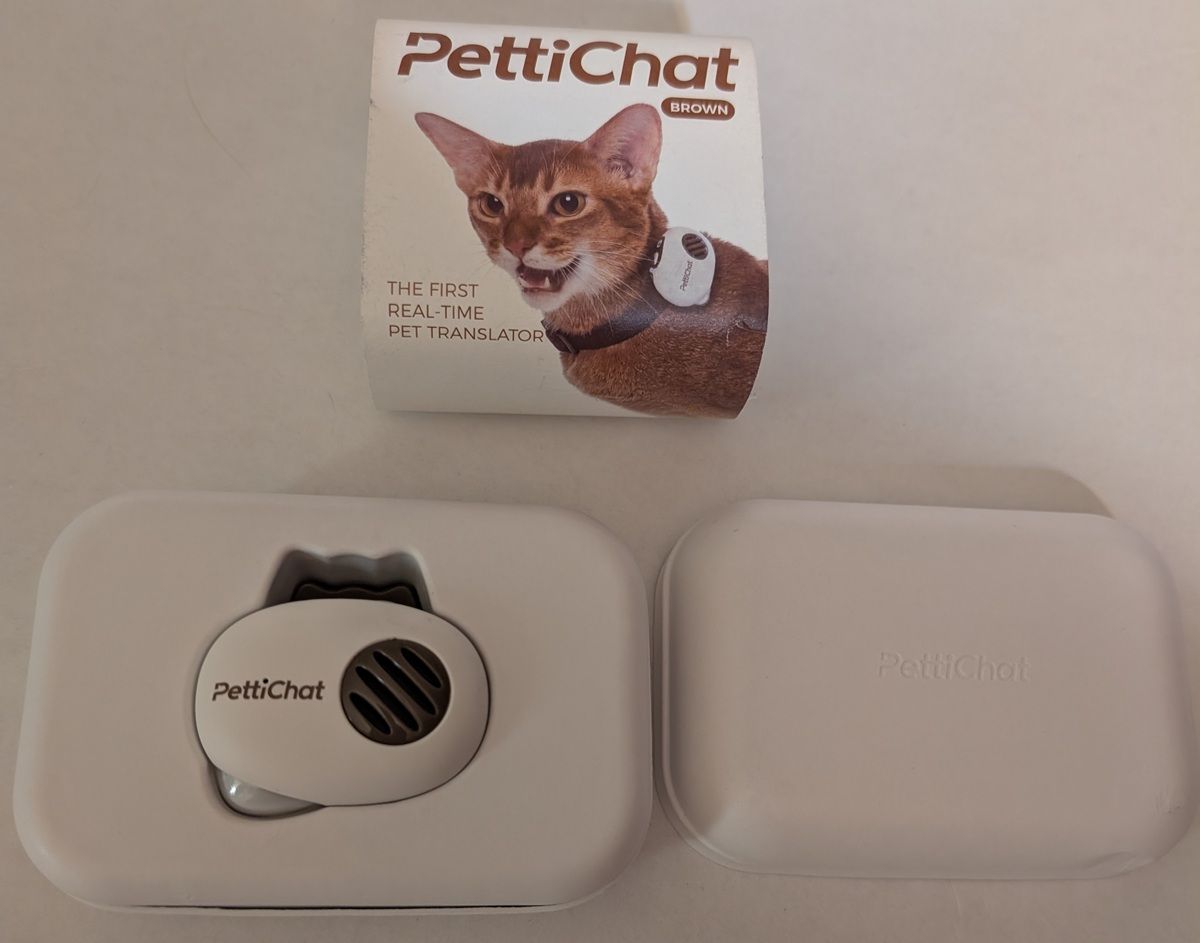
In recent years, technology has given cats new ways to “talk” to their humans, such as by pressing labeled buttons that play recorded messages. Now, a new product called PettiChat from a Chinese startup company has entered the market with a next-level opportunity. With the use of AI, a miniature electronic device that clips to your cat’s collar, and a smartphone app, you can carry on audible conversations with your cat.
It’s an amazing claim. Does PettiChat live up to it?
How We Tested:
- We acquired a PettiChat.
- We spent a few weeks testing the device on one of my cats.
- We did not receive these products in exchange for a favorable review.
Why Trust Cats.com
Our team has tested numerous cat products, and we understand what cat parents like and need.
I acquired a PettiChat as a media sample and spent a few weeks testing the device with one of my six cats. I paid close attention to the details of the device and the app, and how they reflected and interpreted my cat’s sounds. We did not receive this product in exchange for a favorable review.

Kellie Gormly / Cats.com

Kellie Gormly / Cats.com

Kellie Gormly / Cats.com
Brand Overview
The PettiChat company, based in China, reports that a team of experts – including AI engineers, veterinarians, and animal-behavior scientists – worked to develop PettiChat with the goal of enhancing the human-animal bond with technology. The team worked in research and development for two years.
A Kickstarter fundraiser earned more than $151,000 in pledges for PettiChat in the spring, and the company pre-sold more than 10,000 units before the device officially launched, which is huge for a startup. Clearly, the idea of this product is resonating with cat lovers, who want to get inside their cats’ heads! One slogan used for PettiChat is “Love is staying close to what they need.”
In one promotional video, the slogan is: “Love is letting them be heard.”
The company reports 94.6 percent accuracy in translating pet sounds to human language. As of late June, the product is on sale for $149.
PettiChat Features
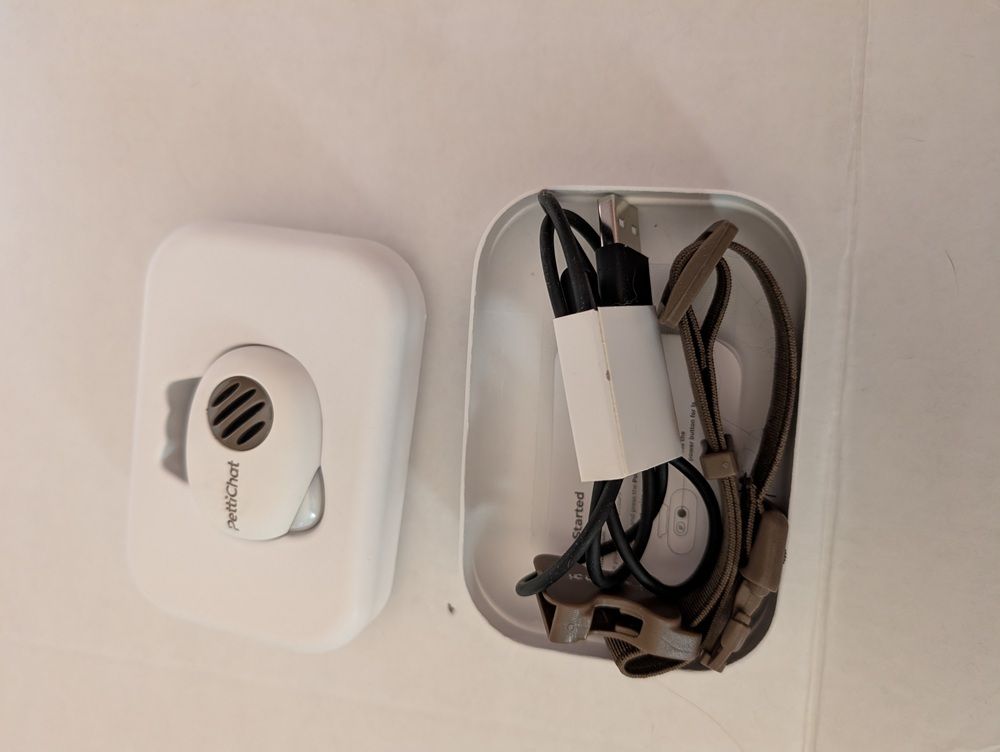
PettiChat is a compact, clip-on device that attaches to the included breakaway collar and is available in brown, pink, and silver. The kit includes the device, collar, and charging cable. Kellie Gormly / Cats.com
The little electronic device, about an inch wide, clips onto a matching collar that comes with the product; the collar has an emergency release feature. The PettiChat comes in three colors: brown, pink, and an electroplated silver. The system supports users in 11 languages: English, Chinese, Spanish, French, Japanese, Korean, Russian, Hindi, Portuguese, German, and Italian.
The PettiChat kit comes with the clip-on computerized device, a collar, and a charging cord for the device. It takes just an hour to charge the PettiChat, which can last for up to 1,000 translations and 100 hours of active tracking on a full charge, the company says.
PettiChat runs in sleep mode when your pet is quiet, and the cat’s meow or other vocalizations should activate it. When your cat vocalizes, the translation text quickly appears on the app. You need to connect the device to the Bluetooth function on your smartphone, and your home Wi-Fi.

PettiChat stays in sleep mode when your pet is quiet and activates when it detects a meow or other vocalization. Translations appear in the app, and the device connects to your smartphone via Bluetooth and your home Wi-Fi. Kellie Gormly / Cats.com

PettiChat stays in sleep mode when your pet is quiet and activates when it detects a meow or other vocalization. Translations appear in the app, and the device connects to your smartphone via Bluetooth and your home Wi-Fi. Kellie Gormly / Cats.com
What We Like:
- It’s just plain cool and fun to communicate with your cat in audible words! The technology here is brilliant, even if it isn’t 100 percent accurate. (Really, how could anything or anyone know exactly what a cat is thinking all the time? Cats are too mysterious for that.)
- The written messages are very cute and sound like something cats would say if they could talk. The AI voice is very childlike, the way we imagine our cats would sound. The messages remain archived on a thread, so you can re-read them. One of my cat’s messages to me: “Tsssss! Quit holding me like that. I’ll go hide in that corner and ignore you for ages if you don’t stop.” (Ouch!) And this one was sweet: “Yaaaa! C’mere, let me nudge my cheek soft against yours. I’ve been waiting to get all cozy and close with you right here.”
- You can also speak back to your cats with recorded messages as well as them speaking to you.
- The PettiChat has GPS tracking, so it is harder to lose your cat. That is a built-in safety feature.
- The adaptive AI translation improves in accuracy over time as it gets to know the individual sounds of your particular pet.
- The accompanying PettiChat app can accommodate several pets, if each has its own collar device. You fill out a profile for each cat – and it works on dogs, too, if you have canines.
What We Didn’t Like:
- The instructions are sparse and need a lot of improvement. The paper instructions come in the Pettichat box on a folded-up strip of paper and don’t get into much detail. The PettiChat app walks you through some things, like what different lights colors on the device mean, but I still found myself confused and trying to figure out a lot of things myself. The YouTube tutorial helps.
- The device seems glitchy at times. Sometimes, when the device should have been on and active, it was in sleep mode, and vice versa. In all fairness, that could be because of my own confusion as I learned to use PettiChat. (Refer back to the last point; it needs better, more detailed instructions.) The GPS feature was off on mine, too; the zoomed-out image showed the device located where my house is, but a zoomed-in image showed that the PettiChat thought my cat was actually at the house next door.
- Some of the initial translations were half truths; my cat was meowing to be let out of her feeding room after dinner, and not seeking affection as the message said. She wanted attention, but for different reasons. But, the AI adapts and gets better and more accurate over time as it gets used to your cat – and that is one of the things we like about PettiChat.
What Did the Test Cats Think?
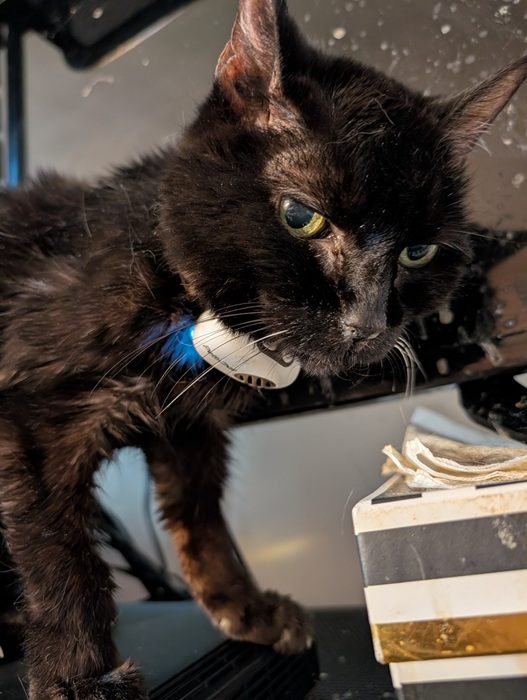
This is GG wearing the device. She may look a little frail—she’s 18 years old and has kidney disease and chronic congestion—but she’s a true fighter. Kellie Gormly / Cats.com
I have a Brady Bunch of a half dozen strictly indoor cats at my house, but none of them wears a collar. This presented a challenge because my cats aren’t used to having collars on their neck, which is required for using PettiChat.
On the app, you program in your pet’s name, so I programmed my PettiChat for Socks Clinton – my almost year-old cat, who is very laid back and tolerant. I assumed he would be the easiest cat to get cooperation from with a collar, but I assumed wrong, Socks squirmed and bolted and just wasn’t having it. I then tried my other laid-back male, Kringle, and had the same results.
The third time was the charm with GG, my elderly 18-year-old cat who can be quite fussy, but she tolerated the collar. I let her get used to it for a few nights before attaching the PettiChat device, and she didn’t mind it at all.
What Do Customers Think of PettiChat?
Since you can only purchase PettiChat directly from the company and not through third-party retailers, there are only reviews on the PettiChat website, which will always be the positive ones. On online forums, many people ridicule the idea of an AI animal translating device, and they are skeptical as to whether it could possibly work. Some people have joked that cats will just insult us and ask us for food (not exactly an unfair prediction).
Many cats with social media profiles have tried PettiChat and have raved about it. The parents of a brown tabby named Bella had this to say on Instagram: “We’ve always wondered what she’s actually trying to say … so we tried this. Switched to ‘cat language’ and started talking to her – and her reactions surprised us. We even asked for a hug and she gave it to us!”
YouTube user @theangelamae calls PettiChat “probably the best investment I ever made” and demonstrates her cat, Mary Jane, talking with the device.